


Does Dark Hair Make You a Winter?

by Anna Lazarska (Poland)

Does Dark Hair Mean You’re a Winter

She sat down in my studio absolutely certain of one thing: she was a Winter. She’d known it for fifteen years. A quiz told her so, then a magazine, then a well-meaning friend, and online color analysis — all pointing to the same “evidence”: dark brown hair and hazel eyes, therefore a Winter.

Ninety minutes of draping later, we were both looking at a Soft Autumn.

Black had been quietly draining her face for a decade and a half. The moment we replaced it with a deep, muted olive, her skin looked rested — as if she’d finally slept. She hadn’t changed. The color context had.

Here’s the uncomfortable truth behind that moment: hair is not a reliable clue to your color Season — but the one people use most.

It is not something you can learn from a book or a chart — it comes from years of draping, testing and analyzing patterns. Which is exactly the training every analyst I certify goes through – the “obvious” answer stops being your first guess fast.

Let’s take this myth apart properly. Not just “it’s wrong,” but why it sounds so logical, why it keeps failing, and how to tell if it has mislabeled you too.

Where the Myth Comes From (and Why It Sounded Logical)

The “dark hair = Winter” rule is outdated.

It comes from the four-Season systems popularized in the 1980s, when color analysis was being explained to millions of people for the first time. Four categories, simple sorting rules: dark hair looks contrasting, contrast reads as “Winter,” done. As a teaching shortcut for a mass audience, it quickly became a stereotype and it worked. You could put it on one page of a magazine.

But a Season stereotype is not a diagnosis. The four-Season model compressed the enormous variety of human coloring into four boxes — and hair color (together with eye color) became the fastest, most visible sorting key. Fast and visible, unfortunately, is not the same as accurate.

A few decades later, the systems have evolved. Modern color analysis works with twelve Seasons precisely because four couldn’t hold the real diversity of people. Yet the old stereotype survived — repeated by quizzes, apps, and social media — because it feels intuitive. Dark hair is dramatic; Winter palettes are dramatic; surely they belong together?

They often don’t. Here’s why.
What Actually Determines Your Season: Hue, Value, Chroma

Your Season is not determined by any single feature. It’s based on your overall coloring — skin, eyes, hair and everything else working together – and how it reacts to three dimensions of color:

Hue — is your coloring warm, cool, or somewhere in between?

Value — how does it react to light and dark colors?

Chroma — does it need clarity, or softness?

That’s not a stylist’s hunch, either — hue, value, and chroma are the three dimensions of the Munsell color system, the scientific backbone SciART-based analysis is built on.

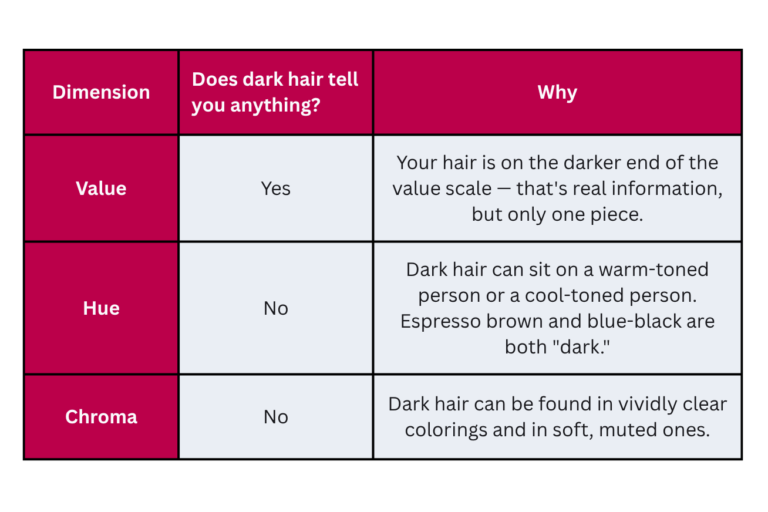
Now look at what dark hair actually tells you within that framework:

One dimension out of three. That’s the entire evidential value of dark hair — and even that one dimension is shared across multiple Seasons.

The Season is never about just a single feature. It’s the relationship between all of them: how your skin looks like next to your eyes, next to your hair, next to a specific piece of colored fabric. That relationship is what draping tests — and what no rule of thumb can override.

One Brunette, Three Different Seasons

If dark hair meant Winter, every dark-haired woman would light up in black, pure white, and icy pink. Walk through any city and you can see that’s not true.

Dark hair appears comfortably in most of the twelve Seasons. Take three women, all with deep brown hair, and put them side by side:

The Dark Winter. Cool-neutral, deep, and clear. Black genuinely serves her — it sharpens her features instead of shadowing them. White looks crisp, not clinical. This is the woman the myth was built on. She exists. She’s just one of several.

The Dark Autumn. Also deep — but warmer. Her best “black” isn’t black at all; it’s bitter chocolate, eggplant, burnt burgundy. Put true black on her and her skin turns faintly gray. Put dark and spicy colors on her and she glows. Same hair depth, different hue.

The Soft Summer. Hair may be quite dark, but everything about her coloring is hazy and gently ashy. Winter’s high-voltage palette overwhelms her — the clothes wear her. In soft, dusty colors — sage, rose brown, slate blue — her face comes forward and the harmony is breathtaking.

Three brunettes. Three different palettes. One myth that would have dressed all three identically — and truly flattered only one of them.

3 Signs Your "Winter" Label Might Be Wrong

If you were labelled as Winter because of your hair, run this quick audit. You’ll need a mirror, daylight, and honesty.

  1. Black near your face makes your skin look gray or tired. On a Winter, black typically adds vitality and definition. If instead it casts shadows under your eyes and makes your complexion look unhealthy, your coloring is likely warmer or softer than the label claims.
  2. Pure white looks “hospital-issue” on you. Stark, blue-white should look crisp and elegant on a Winter. If it looks harsh or cheap next to your skin — while cream or soft white looks expensive — that’s your chroma and hue talking.
  3. Cool, bright lipstick sits on your face like a sticker. Fuchsia pink or clear blue-red should integrate with a Winter’s coloring, enhancing eye color and repeating the tones present in your natural blush. If it visibly separates from your face — if you see the lipstick before you see the woman — the palette is fighting you.

One of these alone is a hint. Two or three together are a pattern — and a good reason to question the label, not your face.

Why a Selfie (or a Quiz) Can't Settle This

At this point you might be tempted to re-take an online quiz or hold your phone up to the mirror. Here’s the honest problem with that — and it’s physics, not gatekeeping.

Light changes everything. The same face reads warmer at sunset, cooler under office LEDs, and differently again in every room of your home. A quiz can’t control the light you’re judging yourself in.

Your screen has an opinion. Every phone applies its own white balance and color processing. The “skin tone” you see in a selfie has already been edited by software and can be perceived differently depending on your screen settings.

There’s no comparison happening. Analysis isn’t about looking at your face in isolation — it’s about watching your face change as controlled colors are placed next to it, one after another, in calibrated light. That real time reaction is the actual data. A static photo simply doesn’t contain it.

This is why professional color analysis is done in person, with physical drapes, with controlled lighting and in an environment that neutralizes color noise. Not because tradition is charming — because that’s where the evidence lives.

So, What Is Your Season?

Your Season answers one question: in which colors does your face come alive? Not “what color is your hair.” Not “what looked good on a celebrity with similar coloring.” Your skin, your eyes, your hair — in relationship and tested against the three dimensions of color.

Dark hair narrows nothing down on its own. It’s one note, and a Season is a chord.

***

If this blog post made you side-eye your own “Winter” label, here’s where to go next:

Get the myth-busting blog posts in your inbox. We publish deep-dives like this regularly — the science of color analysis, minus the 1980s folklore. [Join the Chrysalis Colour newsletter]

And if working out a puzzle like “three brunettes, three answers” is the kind of thing that pulls you in rather than overwhelms you — that’s exactly the instinct I train analysts to trust. [See how my certification program works]

Written by Anna Lazarska, the certified color analysis trainer in Europe, leading Chrysalis Colour since 2025.

Leave a Reply

Your email address will not be published. Required fields are marked *